Publications

2025

Passive Acoustic Dynamic Differentiation and Mapping

Passive Acoustic Dynamic Differentiation and Mapping: A Time-Domain Passive Cavitation Localization and Classification Approach

IEEE TRANSACTIONS ON BIOMEDICAL ENGINEERING. 2026.

Passive cavitation imaging has explored various beamforming algorithms to optimize spatial resolution, suppress imaging artifacts, and maintain computational efficiency. These factors are crucial for the clinical translation of Focused Ultrasound (FUS) therapies, where precise cavitation localization and dose control are required to minimize off-target effects. Commonly used methods such as Delay-Sum-Integrate (DSI) and Robust Capon Beamforming (RCB) have shown utility, but are limited by either significant artifacts or the need for a nonphysical input parameter. This work introduces Passive Acoustic Dynamic Differentiation and Mapping (PADAM), which adapts the Multiple Signal Classification algorithm to the time domain to improve cavitation localization. PADAM offers improved lateral and axial resolutions, artifact suppression, and a physically meaningful input parameter that is intuitive and requires minimal tuning. Additionally, PADAM is computationally more efficient than RCB, as it avoids matrix inversions for every pixel. PADAM’s ability to dynamically distinguish cavitation mechanisms has significant implications in image-guided FUS therapy, particularly for applications requiring selective monitoring of stable versus inertial cavitation.

Download PDF ↓

2024

Preclinical characterization of macrophage-adhering gadolinium micropatches

Preclinical characterization of macrophage-adhering gadolinium micropatches for MRI contrast after traumatic brain injury in pigs

Science Translational Medicine. 2024.

The choroid plexus (ChP) of the brain plays a central role in orchestrating the recruitment of peripheral leukocytes into the central nervous system (CNS) through the blood-cerebrospinal fluid (BCSF) barrier in pathological conditions. We explored whether magnetic resonance imaging of the ChP could be optimized for mild traumatic brain injury (mTBI). mTBI induces subtle, yet influential, changes in the brain and is currently severely underdiagnosed. We hypothesized that mTBI induces sufficient alterations in the ChP to cause infiltration of circulating leukocytes through the BCSF barrier and developed macrophage-adhering gadolinium [Gd(III)]–loaded anisotropic micropatches (GLAMs), specifically designed to image infiltrating immune cells. GLAMs are hydrogel-based discoidal microparticles that adhere to macrophages without phagocytosis. We present a fabrication process to prepare GLAMs at scale and demonstrate their loading with Gd(III) at high relaxivities. In vitro experiments with primary murine and porcine macrophages demonstrated that GLAMs adhere to macrophages also under shear stress and did not affect macrophage viability or functions. Studies in a porcine mTBI model confirmed that intravenously administered macrophage-adhering GLAMs provide a differential signal in the ChP and lateral ventricles at Gd(III) doses 500- to 1000-fold lower than those used in the current clinical standard Gadavist. Under the same mTBI conditions, Gadavist did not offer a differential signal at clinically used doses. Our results suggest that macrophage-adhering GLAMs could facilitate mTBI diagnosis.

Download PDF ↓

2023

Nonspherical ultrasound microbubbles

Nonspherical ultrasound microbubbles

PNAS. 2023.

Surface tension provides microbubbles (MB) with a perfect spherical shape. Here, we demonstrate that MB can be engineered to be nonspherical, endowing them with unique features for biomedical applications. Anisotropic MB were generated via one-dimensionally stretching spherical poly(butyl cyanoacrylate) MB above their glass transition temperature. Compared to their spherical counterparts, nonspherical polymeric MB displayed superior performance in multiple ways, including i) increased margination behavior in blood vessel-like flow chambers, ii) reduced macrophage uptake in vitro, iii) prolonged circulation time in vivo, and iv) enhanced blood–brain barrier (BBB) permeation in vivo upon combination with transcranial focused ultrasound (FUS). Our studies identify shape as a design parameter in the MB landscape, and they provide a rational and robust framework for further exploring the application of anisotropic MB for ultrasound-enhanced drug delivery and imaging applications.

Download PDF ↓
Focused ultrasound enhances transgene expression of intranasal hGDNF DNA nanoparticles

Focused ultrasound enhances transgene expression of intranasal hGDNF DNA nanoparticles in the sonicated brain regions

Journal of Controlled Release. 2023.

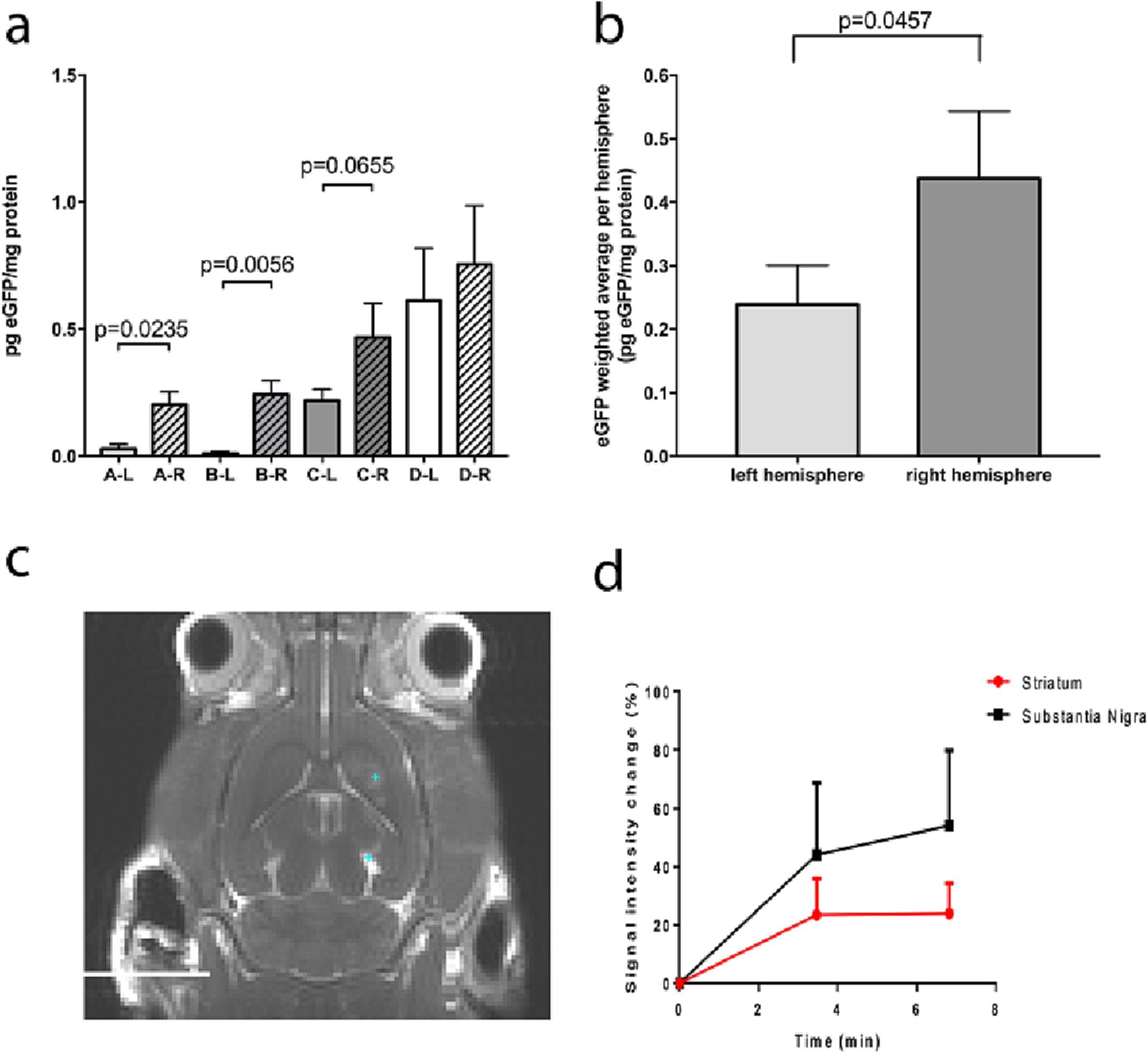
The therapeutic potential of many gene therapies is limited by their inability to cross the blood brain barrier (BBB). While intranasal administration of plasmid DNA nanoparticles (NPs) offers a non-invasive approach to bypass the BBB, it is not targeted to disease-relevant brain regions. Here, our goal was to determine whether focused ultrasound (FUS) can enrich intranasal delivery of our plasmid DNA NPs to target deeper brain regions, in this case the regions most affected in Parkinson’s disease. Combining FUS with intranasal administration resulted in enhanced delivery of DNA NPs to the rodent brain, by recruitment and transfection of microglia. FUS increased transgene expression by over 3-fold after intranasal administration compared to intravenous administration. Additionally, FUS with intranasal delivery increased transgene expression in the sonicated hemisphere by over 80%, altered cellular transfection patterns at the sonication sites, and improved penetration of plasmid NPs into the brain parenchyma (with a 1-fold and 3-fold increase in proximity of transgene expression to neurons in the forebrain and midbrain respectively, and a 40% increase in proximity of transgene expression to dopaminergic neurons in the substantia nigra). These results provide evidence in support of using FUS to improve transgene expression after intranasal delivery of non-viral gene therapies.

Download PDF ↓
Transferrin Receptor-Targeted Nonspherical Microbubbles for Blood-Brain Barrier Sonopermeation

Transferrin Receptor-Targeted Nonspherical Microbubbles for Blood–Brain Barrier Sonopermeation

Advanced Materials. 2023.

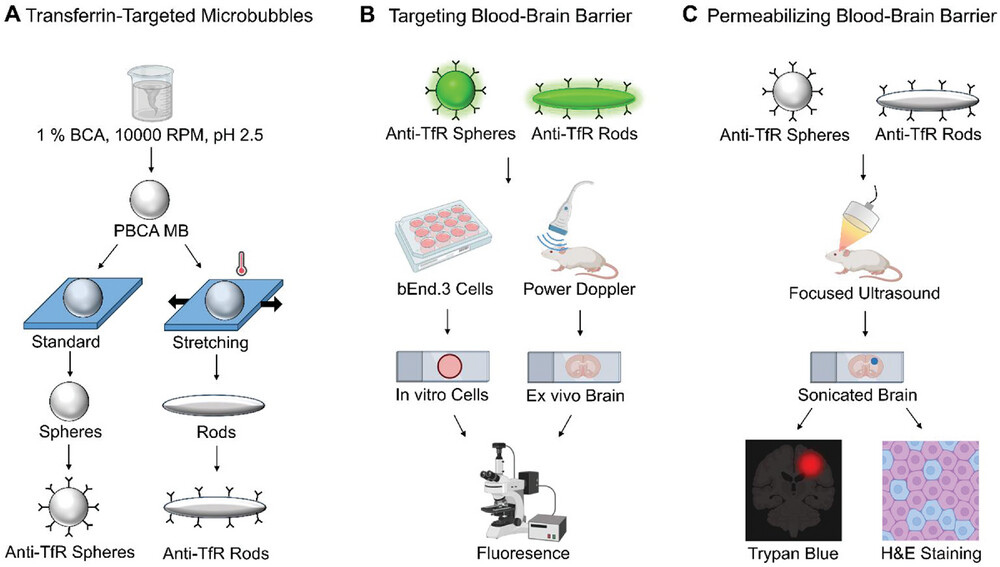
Microbubbles (MB) are widely used for ultrasound (US) imaging and drug delivery. MB are typically spherically shaped, due to surface tension. When heated above their glass transition temperature, polymer-based MB can be mechanically stretched to obtain an anisotropic shape, endowing them with unique features for US-mediated blood–brain barrier (BBB) permeation. It is here shown that nonspherical MB can be surface-modified with BBB-specific targeting ligands, thereby promoting binding to and sonopermeation of blood vessels in the brain. Actively targeted rod-shaped MB are generated via 1D stretching of spherical poly(butyl cyanoacrylate) MB and via subsequently functionalizing their shell with antitransferrin receptor (TfR) antibodies. Using US and optical imaging, it is demonstrated that nonspherical anti-TfR-MB bind more efficiently to BBB endothelium than spherical anti-TfR-MB, both in vitro and in vivo. BBB-associated anisotropic MB produce stronger cavitation signals and markedly enhance BBB permeation and delivery of a model drug as compared to spherical BBB-targeted MB. These findings exemplify the potential of antibody-modified nonspherical MB for targeted and triggered drug delivery to the brain.

Download PDF ↓

2022

Ultrasound-mediated delivery of flexibility-tunable polymer drug conjugates for treating glioblastoma

Ultrasound-mediated delivery of flexibility-tunable polymer drug conjugates for treating glioblastoma

Bioengineering & Translational Medicine. 2022.

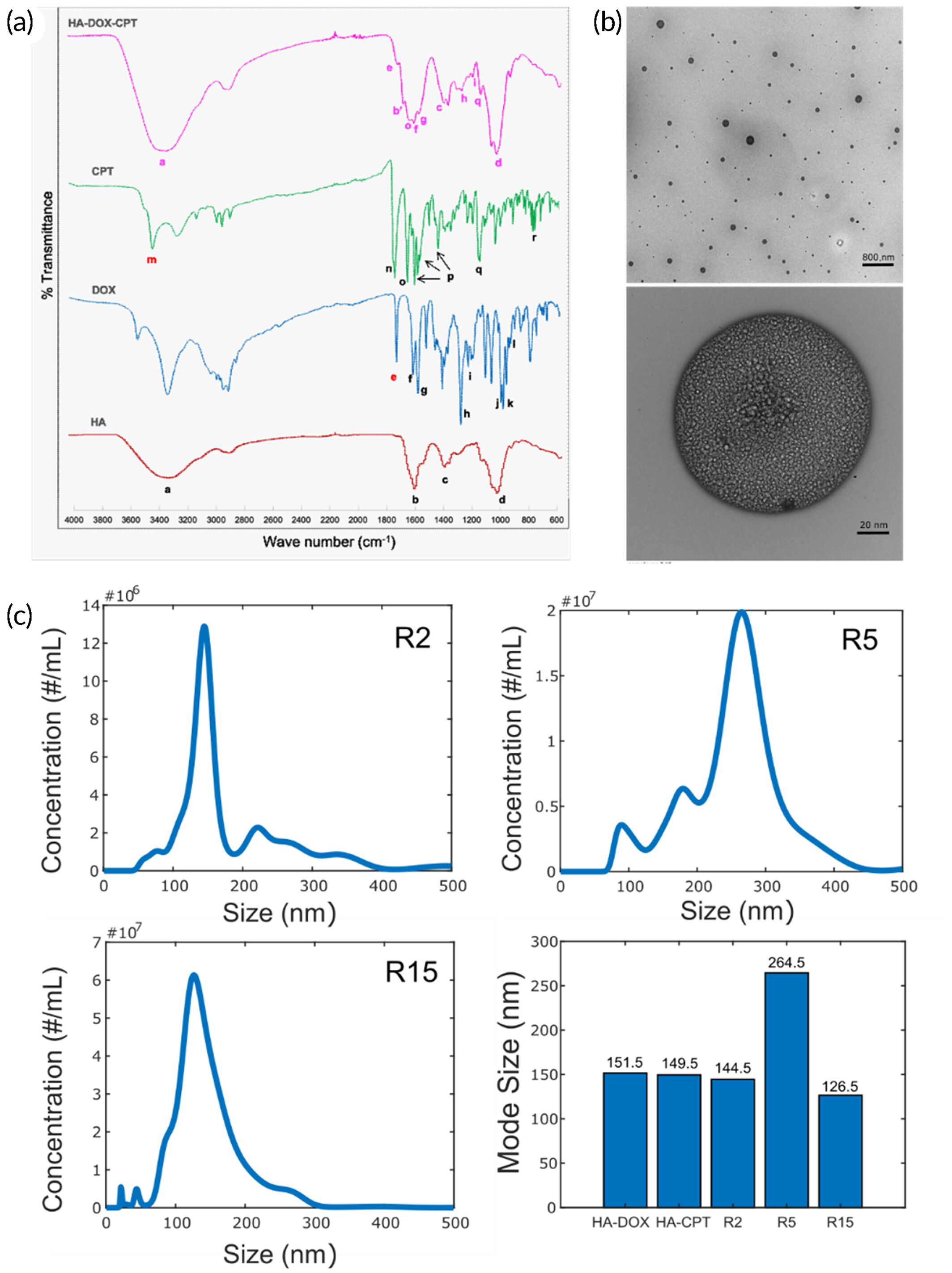
Effective chemotherapy delivery for glioblastoma multiforme (GBM) is limited by drug transport across the blood–brain barrier and poor efficacy of single agents. Polymer–drug conjugates can be used to deliver drug combinations with a ratiometric dosing. However, the behaviors and effectiveness of this system have never been well investigated in GBM models. Here, we report flexible conjugates of hyaluronic acid (HA) with camptothecin (CPT) and doxorubicin (DOX) delivered into the brain using focused ultrasound (FUS). In vitro toxicity assays reveal that DOX-CPT exhibited synergistic action against GBM in a ratio-dependent manner when delivered as HA conjugates. FUS is employed to improve penetration of DOX-HA-CPT conjugates into the brain in vivo in a murine GBM model. Small-angle x-ray scattering characterizations of the conjugates show that the DOX:CPT ratio affects the polymer chain flexibility. Conjugates with the highest flexibility yield the highest efficacy in treating mouse GBM in vivo. Our results demonstrate the association of FUS-enhanced delivery of combination chemotherapy and the drug-ratio-dependent flexibility of the HA conjugates. Drug ratio in the polymer nanocomplex may thus be employed as a key factor to modulate FUS drug delivery efficiency via controlling the polymer flexibility. Our characterizations also highlight the significance of understanding the flexibility of drug carriers in ultrasound-mediated drug delivery systems.

Download PDF ↓
Acute Effects of Focused Ultrasound-Induced Blood-Brain Barrier Opening

Acute Effects of Focused Ultrasound-Induced Blood-Brain Barrier Opening on Anti-Pyroglu3 Abeta Antibody Delivery and Immune Responses

Biomolecules. 2022.

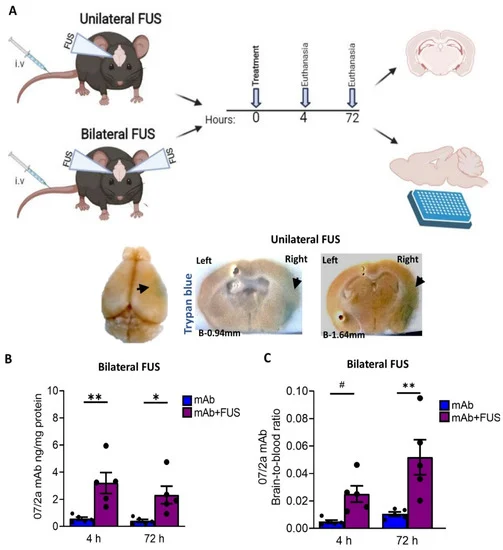
Alzheimer's Disease (AD) is a neurodegenerative disorder characterized by the accumulation of amyloid plaques and hyperphosphorylated tau in the brain. Currently, therapeutic agents targeting amyloid appear promising for AD, however, delivery to the CNS is limited due to the blood-brain-barrier (BBB). Focused ultrasound (FUS) is a method to induce a temporary opening of the BBB to enhance the delivery of therapeutic agents to the CNS. In this study, we evaluated the acute effects of FUS and whether the use of FUS-induced BBB opening enhances the delivery of 07/2a mAb, an anti-pyroglutamate-3 Aβ antibody, in aged 24 mo-old APP/PS1dE9 transgenic mice. FUS was performed either unilaterally or bilaterally with mAb infusion and the short-term effect was analyzed 4 h and 72 h post-treatment. Quantitative analysis by ELISA showed a 5-6-fold increase in 07/2a mAb levels in the brain at both time points and an increased brain-to-blood ratio of the antibody.

Download PDF ↓

2021

Focused ultrasound with anti-pGlu3 Aβ enhances efficacy in Alzheimer's disease-like mice

Focused ultrasound with anti-pGlu3 Aβ enhances efficacy in Alzheimer's disease-like mice via recruitment of peripheral immune cells

Journal of Controlled Release. 2021.

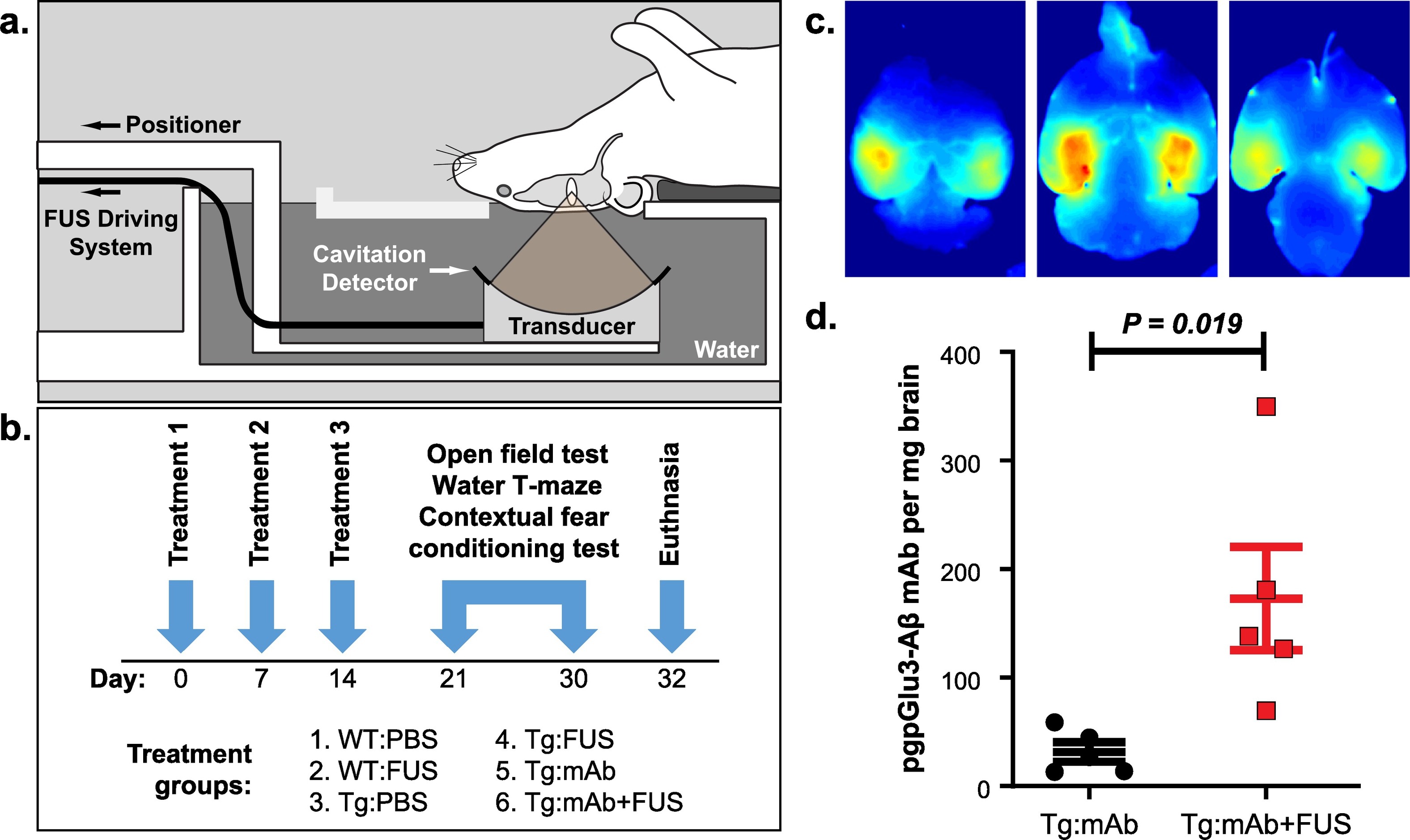
Pyroglutamate-3 amyloid-β (pGlu3 Aβ) is an N-terminally modified, pathogenic form of amyloid-β that is present in cerebral amyloid plaques and vascular deposits. Here, we used focused ultrasound (FUS) with microbubbles to enhance the intravenous delivery of an Fc-competent anti-pGlu3 Aβ monoclonal antibody, 07/2a mAb, across the blood brain barrier (BBB) in an attempt to improve Aβ removal and memory in aged APP/PS1dE9 mice, an Alzheimer's disease (AD)-like model of amyloidogenesis. First, we demonstrated that bilateral hippocampal FUS-BBB disruption (FUS-BBBD) led to a 5.5-fold increase of 07/2a mAb delivery to the brains compared to non-sonicated mice 72 h following a single treatment. Then, we determined that three weekly treatments with 07/2a mAb alone improved spatial learning and memory in aged, plaque-rich APP/PS1dE9 mice, and that this improvement occurred faster and in a higher percentage of animals when combined with FUS-BBBD. Mice given the combination treatment had reduced hippocampal plaque burden compared to PBS-treated controls. Furthermore, synaptic protein levels were higher in hippocampal synaptosomes from mice given the combination treatment compared to sham controls, and there were more CA3 synaptic puncta labeled in the APP/PS1dE9 mice given the combination treatment compared to those given mAb alone. Plaque-associated microglia were present in the hippocampi of APP/PS1dE9 mice treated with 07/2a mAb with and without FUS-BBBD. However, we discovered that plaque-associated Ly6G+ monocytes were only present in the hippocampi of APP/PS1dE9 mice that were given FUS-BBBD alone or even more so, the combination treatment. Lastly, FUS-BBBD did not increase the incidence of microhemorrhage in mice with or without 07/2a mAb treatment. Our findings suggest that FUS is a useful tool to enhance delivery and efficacy of an anti-pGlu3 Aβ mAb for immunotherapy either via an additive effect or an independent mechanism. We revealed a potential novel mechanism wherein the combination of 07/2a mAb with FUS-BBBD led to greater monocyte infiltration and recruitment to plaques in this AD-like model. Overall, these effects resulted in greater plaque removal, sparing of synapses and improved cognitive function without causing overt damage, suggesting the possibility of FUS-BBBD as a noninvasive method to increase the therapeutic efficacy of drugs or biologics in AD patients.

Download PDF ↓
Engineering Caged Microbubbles for Controlled Acoustic Cavitation and Pressure Sensing

Engineering Caged Microbubbles for Controlled Acoustic Cavitation and Pressure Sensing

ACS Materials Letters. 2021.

Acoustic microbubbles (MBs) are an important class of biomaterials that play an increasingly prominent role in advanced applications such as contrast and super-resolution imaging, sonoporation, drug delivery, microrobotics, and biosensors. The ability to control and regulate acoustic cavitation of MBs by ultrasound (US) pulses is fundamental to achieve these applications. However, most MBs are coated with a soft shell that may undergo alteration (e.g., rupture or dissolution) under insonification and result in unintended acoustic responses. This work introduces a system of stable polymeric caged MBs in which the gas core is encapsulated within a rigid but nanoporous shell, so that their acoustic response is regulated by both shell compressibility and metastructure (i.e., porosity), thus permitting high control over their cavitation behaviors via pulse manipulation. These caged MBs are fabricated via a method of interfacial nanoprecipitation. Fabrication parameters can be varied to manipulate shell elasticity and porosity and subsequently control a wide range of acoustic properties such as tuning resonance frequency, controlling modes of nonlinear cavitation. Furthermore, the cavitation of caged MBs can be manipulated to develop tunable acoustic pressure sensors.

Download PDF ↓

2020

Physical triggering strategies for drug delivery

Physical triggering strategies for drug delivery

Advanced Drug Delivery Reviews. 2020.

Physically triggered systems hold promise for improving drug delivery by enhancing the controllability of drug accumulation and release, lowering non-specific toxicity, and facilitating clinical translation. Several external physical stimuli including ultrasound, light, electric fields and magnetic fields have been used to control drug delivery. They share common features such as spatial targeting, spatiotemporal control, and minimal invasiveness, while possessing distinctive features in terms of interactions with biological entities. This review covers the key advances with a focus on physical mechanisms, design rationales, and translational challenges.

Download PDF ↓
Engineering of Living Cells with Polyphenol-Functionalized Biologically Active Nanocomplexes

Engineering of Living Cells with Polyphenol-Functionalized Biologically Active Nanocomplexes

Advanced Materials. 2020.

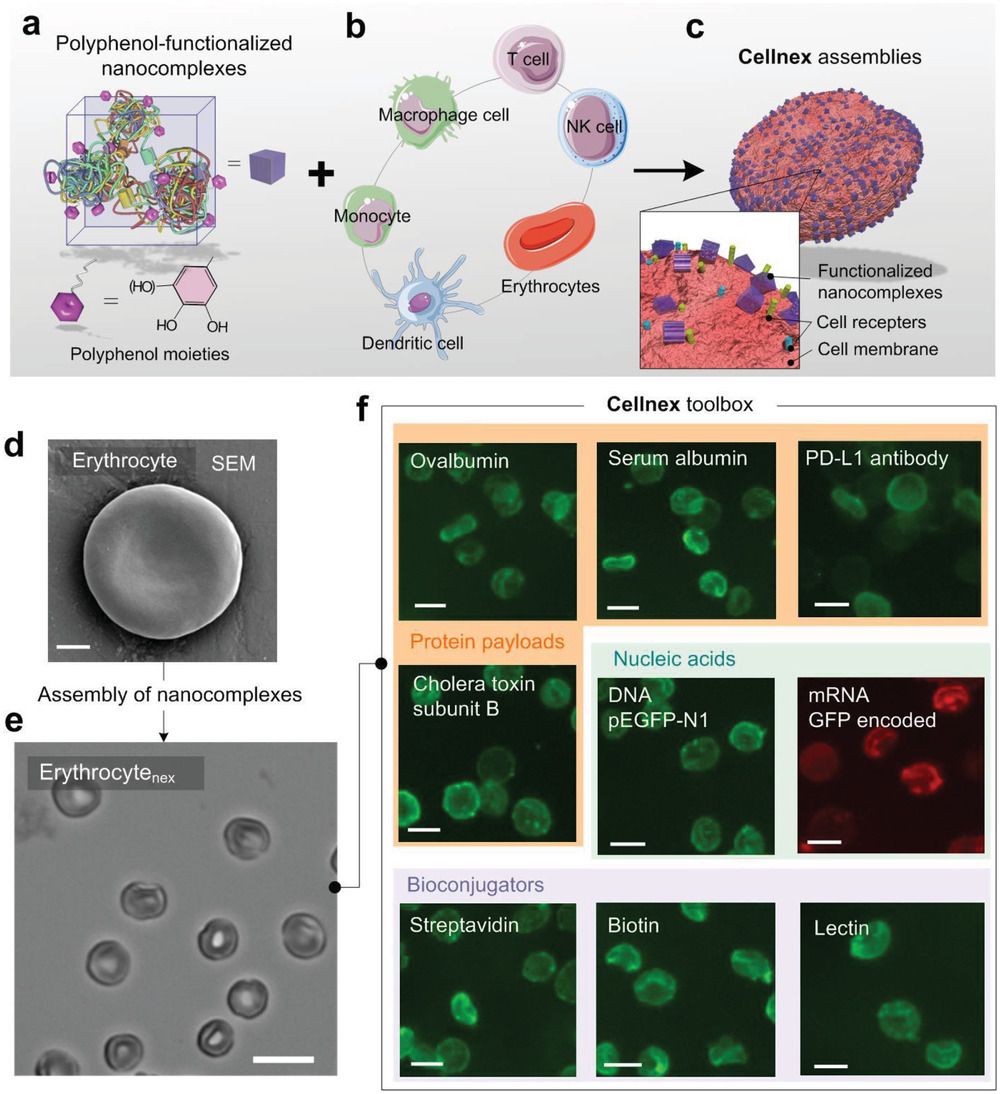
Approaches to safely and effectively augment cellular functions without compromising the inherent biological properties of the cells, especially through the integration of biologically labile domains, remain of great interest. Here, a versatile strategy to assemble biologically active nanocomplexes, including proteins, DNA, mRNA, and even viral carriers, on cellular surfaces to generate a cell-based hybrid system referred to as “Cellnex” is established. This strategy can be used to engineer a wide range of cell types used in adoptive cell transfers, including erythrocytes, macrophages, NK cells, T cells, etc. Erythrocytenex can enhance the delivery of cargo proteins to the lungs in vivo by 11-fold as compared to the free cargo counterpart. Biomimetic microfluidic experiments and modeling provided detailed insights into the targeting mechanism. In addition, Macrophagenex is capable of enhancing the therapeutic efficiency of anti-PD-L1 checkpoint inhibitors in vivo.

Download PDF ↓
Blood-brain barrier disruption and delivery of irinotecan in a rat model

Blood-brain barrier disruption and delivery of irinotecan in a rat model using a clinical transcranial MRI-guided focused ultrasound system

Scientific Reports. 2020.

We investigated controlled blood-brain barrier (BBB) disruption using a low-frequency clinical transcranial MRI-guided focused ultrasound (TcMRgFUS) device and evaluated enhanced delivery of irinotecan chemotherapy to the brain and a rat glioma model. Animals received three weekly sessions of FUS, FUS and 10 mg/kg irinotecan, or irinotecan alone. In each session, four volumetric sonications targeted 36 locations in one hemisphere. With feedback control based on recordings of acoustic emissions, 98% of the sonication targets (1045/1071) reached a pre-defined level of acoustic emission, while the probability of wideband emission (a signature for inertial cavitation) was less than 1%. BBB disruption, evaluated by mapping the R1 relaxation rate after administration of an MRI contrast agent, was significantly higher in the sonicated hemisphere (P < 0.01). Histological evaluation found minimal tissue effects. Irinotecan concentrations in the brain were significantly higher (P < 0.001) with BBB disruption. Overall these results demonstrate safe and controlled BBB disruption with a low-frequency clinical TcMRgFUS device. While irinotecan delivery to the brain was not neurotoxic, it did not improve outcomes in the F98 glioma model.

Download PDF ↓
Hyaluronic acid-doxorubicin nanoparticles for targeted treatment of colorectal cancer

Hyaluronic acid–doxorubicin nanoparticles for targeted treatment of colorectal cancer

Bioengineering & Translational Medicine. 2020.

Colorectal cancer, common in both men and women, occurs when tumors form in the linings of the colon. Common treatments of colorectal cancer include surgery, chemotherapy, and radiation therapy; however, many colorectal cancer treatments often damage healthy tissues and cells, inducing severe side effects. Conventional chemotherapeutic agents such as doxorubicin (Dox) can be potentially used for the treatment of colorectal cancer; however, they suffer from limited targeting and lack of selectivity. Here, we report that doxorubicin complexed to hyaluronic acid (HA) (HA-Dox) exhibits an unusual behavior of high accumulation in the intestines for at least 24 hr when injected intravenously. Intravenous administrations of HA-Dox effectively preserved the mucosal epithelial intestinal integrity in a chemical induced colon cancer model in mice. Moreover, treatment with HA-Dox decreased the expression of intestinal apoptotic and inflammatory markers.

Download PDF ↓
Local anesthesia enhanced with increasing high-frequency ultrasound intensity

Local anesthesia enhanced with increasing high-frequency ultrasound intensity

Drug Delivery and Translational Research. 2020.

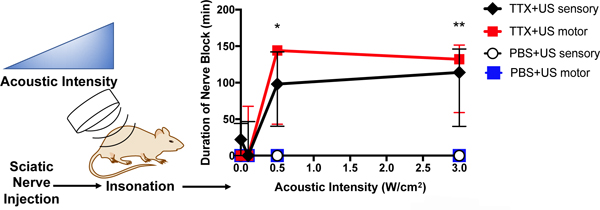
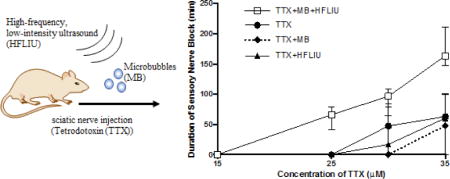
The effect of local anesthetics, particularly those which are hydrophilic, such as tetrodotoxin, is impeded by tissue barriers that restrict access to individual nerve cells. In this study, we examined the effect of acoustic intensity on nerve block by tetrodotoxin and compared it to the effect on nerve block by bupivacaine, a more hydrophobic local anesthetic. Insonation with 1-MHz ultrasound at acoustic intensity greater than 0.5 W/cm² improved nerve block effectiveness, increased nerve block reliability, and prolonged both sensory and motor nerve blockade mediated by the hydrophilic ultra-potent local anesthetic, tetrodotoxin. There was minimal or no tissue injury from ultrasound treatment.

Download PDF ↓

2019

Acoustic feedback enables safe and reliable carboplatin delivery across the blood-brain barrier

Acoustic feedback enables safe and reliable carboplatin delivery across the blood-brain barrier with a clinical focused ultrasound system

Theranostics. 2019.

The blood-brain barrier (BBB) restricts delivery of most chemotherapy agents to brain tumors. Here, we investigated a clinical focused ultrasound (FUS) device to disrupt the BBB in rats and enhance carboplatin delivery to the brain using the F98 glioma model. In each rat, 2–3 volumetric sonications targeted 18–27 locations in one hemisphere. Sonication was combined with Definity microbubbles and followed by intravenous carboplatin. Closed-loop feedback control was performed based on acoustic emissions analysis. Safety and reliability were established in healthy rats after three sessions with carboplatin; BBB disruption was induced in every target without significant damage evident in MRI or histology. Tissue-to-plasma ratios of intact carboplatin concentrations were increased by 7.3 and 2.9 times in brain and tumor respectively. Tumor volume doubling time in rats receiving FUS and carboplatin increased by 96% and 126% compared to rats that received carboplatin alone and non-sonicated controls; corresponding increases in median survival were 48% and 66%. Overall, this work demonstrates that actively-controlled BBB disruption with a clinical device can enhance carboplatin delivery without neurotoxicity at a level that reduces tumor growth and improves survival in an aggressive and infiltrative rat glioma model.

Download PDF ↓
Amelioration of the nigrostriatal pathway facilitated by ultrasound-mediated neurotrophic delivery

Amelioration of the nigrostriatal pathway facilitated by ultrasound-mediated neurotrophic delivery in early Parkinson's disease

Journal of Controlled Release. 2019.

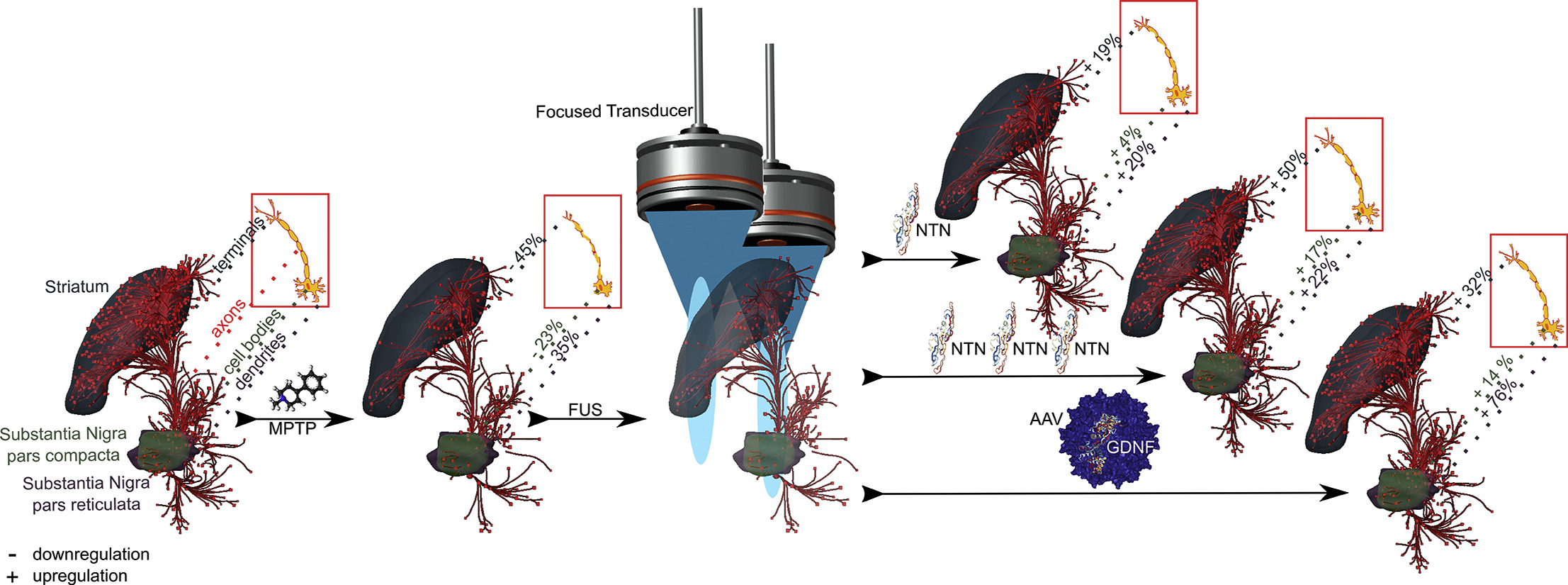
The blood-brain barrier (BBB) prevents most drugs from gaining access to the brain parenchyma, which is a recognized impediment to the treatment of neurodegenerative disorders like Parkinson’s disease (PD). Focused ultrasound (FUS), in conjunction with systemically administered microbubbles, opens the BBB locally, reversibly and non-invasively. Herein, we show that neither FUS applied over both the striatum and the ventral midbrain, without neurotrophic factors, nor intravenous administration of neurotrophic factors (either through protein or gene delivery) without FUS, ameliorates the damage to the nigrostriatal dopaminergic pathway in the sub-acute MPTP mouse model of early-stage PD. Conversely, the combination of FUS and intravenous neurotrophic (protein or gene) delivery attenuates the damage to the nigrostriatal dopaminergic pathway, by allowing the entry of these agents into the brain parenchyma. Our findings provide evidence that the application of FUS at the early stages of PD facilitates critical neurotrophic delivery that can curb the rapid progression of neurodegeneration while improving the neuronal function.

Download PDF ↓
Intracranial Non-thermal Ablation Mediated by Transcranial Focused Ultrasound and Phase-Shift Nanoemulsions

Intracranial Non-thermal Ablation Mediated by Transcranial Focused Ultrasound and Phase-Shift Nanoemulsions

Ultrasound in Medicine & Biology. 2019.

High intensity focused ultrasound (HIFU) mechanical ablation is an emerging technique for non-invasive transcranial surgery. Lesions are created by driving inertial cavitation in tissue, which requires significantly less peak pressure and time-averaged power compared with traditional thermal ablation. The utility of mechanical ablation could be extended to the brain provided the pressure threshold for inertial cavitation can be reduced. In this study, the utility of perfluorobutane (PFB)-based phase-shift nanoemulsions (PSNEs) for lowering the inertial cavitation threshold and enabling focal mechanical ablation in the brain was investigated. We successfully achieved vaporization of PFB-based PSNEs at 1.8 MPa with a 740 kHz focused transducer with a pulsed sonication protocol within intact CD-1 mice brains. Histologic analysis revealed ischemic and hemorrhagic lesions with dimensions comparable to the focal zone of the transducer.

Download PDF ↓
Artifact Suppression for Passive Cavitation Imaging Using U-Net CNNs with Uncertainty Quantification

Artifact Suppression for Passive Cavitation Imaging Using U-Net CNNs with Uncertainty Quantification

IEEE IUS. 2019.

The clinical applications of chemotherapy treatments for brain tumors are limited by the blood-brain barrier (BBB) which blocks drugs from reaching the tumors. Magnetic resonance imaging (MRI)-guided focused ultrasound (FUS) is applied to the brain to create micro-bubbles in the BBB for opening the BBB temporarily for targeted drug delivery. Creation of these microbubbles is monitored using passive cavitation imaging (PCI). Generally, PCI utilizes delay-and-sum (DAS) beamforming, which suffers from a space-varying point spread function and high sidelobes both of which introduce image artifacts. To address this issue and to better monitor the BBB opening, a deep learning denoising approach is proposed based on a U-Net convolutional neural networks (CNN) architecture. The U-Net is trained with pairs of images, with DAS passive cavitation images at the input layer, and ground truth noise-free images at the output layer.

Download PDF ↓

2018

High-frequency, low-intensity ultrasound and microbubbles enhance nerve blockade

High-frequency, low-intensity ultrasound and microbubbles enhance nerve blockade

Journal of Controlled Release. 2018.

Using an in vivo model system of local anesthetic delivery, we demonstrate that treatment with high-frequency, low-intensity ultrasound together with microbubbles improved nerve block effectiveness, increased nerve block reliability, and resulted in a prolongation of both sensory and motor nerve blockade mediated by the hydrophilic ultrapotent local anesthetic, tetrodotoxin. Co-application of HFLIU and microbubbles resulted in statistically significant increases in the percentage of successful motor block. The same approach did not work with the more hydrophobic drug bupivacaine.

Download PDF ↓

2017

Closed-loop control of targeted ultrasound drug delivery across the blood-brain/tumor barriers

Closed-loop control of targeted ultrasound drug delivery across the blood–brain/tumor barriers in a rat glioma model

PNAS. 2017.

Cavitation-facilitated microbubble-mediated focused ultrasound therapy is a promising method of drug delivery across the blood–brain barrier (BBB) for treating many neurological disorders. Unlike ultrasound thermal therapies, during which magnetic resonance thermometry can serve as a reliable treatment control modality, real-time control of modulated BBB disruption with undetectable vascular damage remains a challenge. Here a closed-loop cavitation controlling paradigm that sustains stable cavitation while suppressing inertial cavitation behavior was designed and validated using a dual-transducer system operating at the clinically relevant ultrasound frequency of 274.3 kHz. Tests in the normal brain and in the F98 glioma model in vivo demonstrated that this controller enables reliable and damage-free delivery of a predetermined amount of the chemotherapeutic drug (liposomal doxorubicin) into the brain.

Download PDF ↓
Transcranial cavitation-mediated ultrasound therapy via temporal interference modulation

Transcranial cavitation-mediated ultrasound therapy at sub-MHz frequency via temporal interference modulation

Applied Physics Letters. 2017.

Sub-megahertz transmission is not usually adopted in pre-clinical small animal experiments for focused ultrasound (FUS) brain therapy due to the large focal size. However, low frequency FUS is vital for preclinical evaluations due to the frequency-dependence of cavitation behavior. To maximize clinical relevance, a dual-aperture FUS system was designed for low-frequency (274.3 kHz) cavitation-mediated FUS therapy. Combining two spherically curved transducers provides significantly improved focusing in the axial direction while yielding an interference pattern with strong side lobes, leading to inhomogeneously distributed cavitation activities. A temporal interference modulation approach was developed to homogenize the cavitation activities across the focal region by varying the relative phase of the two transducers over time.

Download PDF ↓

2016

Direct brain infusion can be enhanced with focused ultrasound and microbubbles

Direct brain infusion can be enhanced with focused ultrasound and microbubbles

Journal of Cerebral Blood Flow & Metabolism. 2016.

The delivery of most therapeutic agents is rendered ineffective for the treatment of brain diseases due to the presence of the blood–brain barrier (BBB). The goal of this study was to investigate the effect of pre-infusion focused ultrasound (FUS) and microbubbles on the distribution of direct brain infusion in vivo. A single-element FUS transducer was used in all sonications, which were carried out immediately prior to direct infusion procedures. Mice received direct infusion of either Gadolinium-labeled albumin (Gd-albumin, 74 kDa) or adeno-associated virus (AAV, ∼4 MDa). The volumes of Gd-albumin at 30 min were deemed comparable (P = 0.334) between the direct infusion (DI)-only group and the FUS + DI group. At 120 min, the FUS + DI group showed significantly higher contrast-enhanced volume (9.76 ± 0.74 mm³) than the DI-only group (7.14 ± 0.34 mm³). For mice infused with AAV, the FUS + DI group demonstrated significantly higher (P = 0.017) transduction efficiency in vivo. In conclusion, enhanced bio-distribution of directly infused agents was observed when the targeted region was pre-conditioned with FUS and microbubbles.

Download PDF ↓

2015

Acoustic cavitation-based monitoring of the reversibility and permeability of ultrasound-induced blood-brain barrier opening

Acoustic cavitation-based monitoring of the reversibility and permeability of ultrasound-induced blood-brain barrier opening

Physics in Medicine & Biology. 2015.

Cavitation events seeded by microbubbles have been previously reported to be associated with MR- or fluorescent-contrast enhancement after focused ultrasound (FUS)-induced blood-brain barrier (BBB) opening. However, it is still unknown whether bubble activity can be correlated with the reversibility (the duration of opening and the likelihood of safe reinstatement) and the permeability of opened BBB, which is critical for the clinical translation of using passive cavitation detection to monitor, predict and control the opening. In this study, the dependence of acoustic cavitation on the BBB opening duration, permeability coefficient and histological damage occurrence were investigated. Stable cavitation was found to be more reliable than inertial cavitation at assessing the BBB opening within the pressure range used. This study demonstrates that the stable cavitation response during BBB opening holds promise for predicting and controlling the restoration and pharmacokinetics of FUS-opened BBB.

Download PDF ↓

2014

Noninvasive neuron-specific gene therapy facilitated by focused ultrasound and recombinant adeno-associated virus

Noninvasive, neuron-specific gene therapy can be facilitated by focused ultrasound and recombinant adeno-associated virus

Gene Therapy. 2014.

Recombinant adeno-associated virus (rAAV) has shown great promise as a potential cure for neurodegenerative diseases. The existence of the blood-brain barrier (BBB), however, hinders efficient delivery of the viral vectors. Direct infusion through craniotomy is the most commonly used approach to achieve rAAV delivery, which carries increased risks of infection and other complications. Here, we report a focused ultrasound (FUS)-facilitated noninvasive rAAV delivery paradigm that is capable of producing targeted and neuron-specific transductions. Oscillating ultrasound contrast agents (microbubbles), driven by FUS waves, temporarily 'unlock' the BBB, allowing the systemically administrated rAAVs to enter the brain parenchyma, while maintaining their bioactivity and selectivity. Taking the advantage of the neuron-specific promoter synapsin, rAAV gene expression was triggered almost exclusively (95%) in neurons of the targeted caudate-putamen region.

Download PDF ↓
A New Brain Drug Delivery Strategy: Focused Ultrasound-Enhanced Intranasal Drug Delivery

A New Brain Drug Delivery Strategy: Focused Ultrasound-Enhanced Intranasal Drug Delivery

PLOS ONE. 2014.

Central nervous system (CNS) diseases are difficult to treat because of the blood-brain barrier (BBB), which prevents most drugs from entering into the brain. Intranasal (IN) administration is a promising approach for drug delivery to the brain, bypassing the BBB; however, its application has been restricted to particularly potent substances and it does not offer localized delivery to specific brain sites. Focused ultrasound (FUS) in combination with microbubbles can deliver drugs to the brain at targeted locations. The present study proposed to combine these two different platform techniques (FUS+IN) for enhancing the delivery efficiency of intranasally administered drugs at a targeted location. After IN administration of 40 kDa fluorescently-labeled dextran as the model drug, FUS targeted at one region within the caudate putamen of mouse brains was applied in the presence of systemically administered microbubbles. The results showed that FUS+IN enhanced drug delivery within the targeted region compared with that achieved by IN alone, suggesting this combined approach as a new strategy for noninvasive, localized brain drug delivery.

Download PDF ↓

2012

Ambient pressure dependence of the ultra-harmonic response from contrast microbubbles

Ambient pressure dependence of the ultra-harmonic response from contrast microbubbles

Journal of the Acoustical Society of America. 2012.

Sub-harmonic response from ultrasound contrast agent microbubbles has been demonstrated to be an effective modality for noninvasive pressure measurement. In the present study, the dependence of ultra-harmonic response on the ambient overpressure was investigated by both experimental measurements and simulations. The microbubbles were exposed to Gaussian pulses with varied driving frequencies and pulse lengths, at an acoustic pressure of 0.3 MPa. The amplitudes of sub- and ultra-harmonic components were measured when the ambient overpressures varied from 0–25 kPa. At the driving frequency of 1.33 MHz, the ultra-harmonic energy decreased but the sub-harmonic energy increased with the increasing overpressure; while at 4 MHz, both components showed a decreasing trend. A 4-MHz Gaussian pulse with 64 cycles could provide an ultra-harmonic response with both good ambient pressure sensitivity and high linearity. Furthermore, the effects of shell parameters on the generation of ultra- and sub-harmonic responses were discussed based on simulations using Marmottant’s model. This study suggests that the ultra-harmonic response from contrast microbubbles might be applicable for noninvasive pressure measurement.

Download PDF ↓